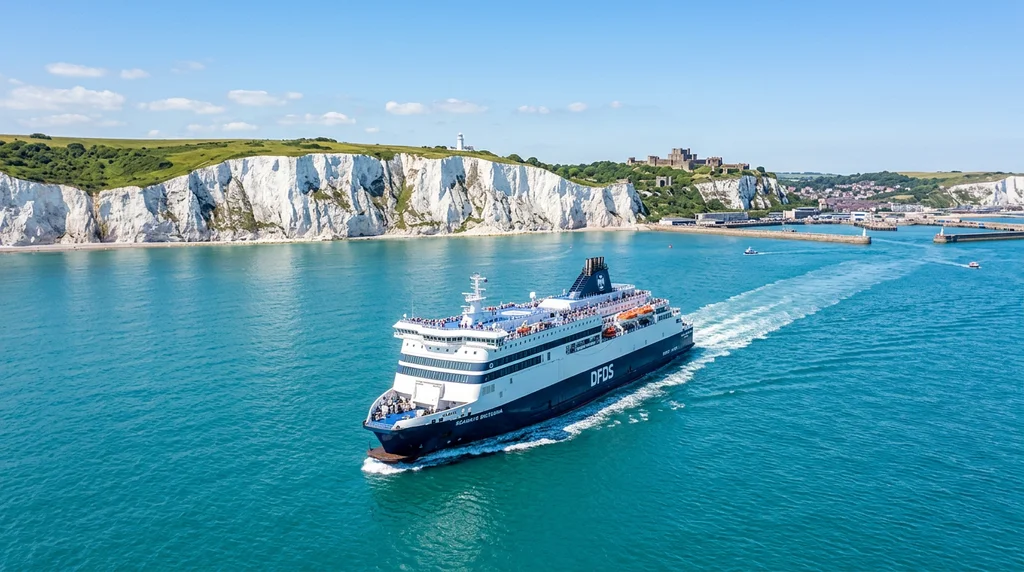
The Dover to Calais ferry is the UK's busiest and shortest Channel crossing, run by P&O Ferries, DFDS, and Irish Ferries. Compare crossing times, prices and foot passenger rules below.
Crossing time
1h 30m–1h 40m
Operators
P&O Ferries, DFDS, Irish Ferries
Daily sailings
30+ combined
Foot passengers
P&O only
All three operators run the same route, but they're not interchangeable — foot passenger access, check-in times and crossing length all vary. Here's how they compare:
Compare Dover-Calais operators

- Duration ~90 min
- Foot Passengers Yes
- Check-in 90 min (foot)
60 min (vehicle)

- Duration ~100 min
- Foot Passengers No (Vehicle only)
- Check-in 60 min

- Duration ~90 min
- Foot Passengers No (Vehicle only)
- Check-in 60 min
| Operator | Duration | Foot Passengers | Check-in | Booking |
|---|---|---|---|---|
| | ~90 min | Yes | 90 min (foot) 60 min (vehicle) | Check Prices » |
| | ~100 min | No (Vehicle only) | 60 min | Check Prices » |
| | ~90 min | No (Vehicle only) | 60 min | Check Prices » |
Companies operating between Dover and Calais
Three operators run the Dover to Calais crossing, and each has a slightly different focus.
- P&O Ferries: is based in Dover and runs Dover-Calais as one of just three routes it operates in total, alongside Hull-Rotterdam and Cairnryan-Larne — it's the only one of the three offering foot passenger travel on this crossing.
- DFDS: a Danish operator, runs a wider UK network including Dover-Dunkirk, Newhaven-Dieppe, Newcastle-Amsterdam and Jersey routes, and requires a vehicle on Dover-Calais.
- Irish Ferries: part of Irish Continental Group, primarily serves Ireland routes such as Dublin-Holyhead and Rosslare-Pembroke — Dover-Calais, added in 2021, is its only route that doesn't touch Ireland, and like DFDS, it requires a vehicle.
Per GOV.UK's Sea Passenger Statistics, this single route accounts for roughly 78% of all passenger movement through the Port of Dover — by far the dominant crossing at the UK's busiest ferry port. This page covers the crossing in both directions: Dover to Calais and Calais to Dover run on the same ships and the same timetable.
Dover ferry port: terminal, parking and facilities
Dover ferry port is based at Eastern Docks (postcode CT16 1JA), on the east side of the harbour — not to be confused with the Western Docks, which handles cruise ships. There's no parking within the port itself, so if you're not taking a vehicle onto the ferry, you'll need to arrange off-site parking in advance rather than turning up and hoping to leave a car behind.
Inside the Passenger Terminal Building, you'll find a Costa Coffee kiosk, a Border Force public counter, a dedicated P&O foot passenger ticket desk, toilets, and two pet exercise areas.
If you're travelling as a foot passenger — only possible with P&O on this route — you'll check in at the Passenger Terminal Building and then be taken to the ship by shuttle bus rather than walking to it directly.
What to expect on board the Dover to Calais ferry
P&O's Dover-Calais ships have a Junior Crew Kids' Club and a Deep Sea Pioneers app to keep children entertained during the crossing, along with a paid Pet Lounge for dogs travelling either as foot passengers or in a vehicle.
Cats and ferrets need to stay in the vehicle throughout the crossing on all three operators.
If Calais isn't your final destination and you'd rather land somewhere else in northern France, DFDS also runs a separate Dover to Dunkirk service, with a slightly longer crossing of around 2 hours and no foot passenger option.
Prefer traveling by train? Compare Dover ferries with LeShuttle Eurotunnel car train deals from Folkestone to Calais (35 minutes).
How to find the cheapest ferry to France
Looking for the cheapest ferry to France? Because Dover-Calais runs more than 30 sailings a day across three operators, there's more flexibility to find a cheaper sailing time on the day itself than on routes with fewer daily crossings, where booking further ahead tends to matter more.
That said, Tuesday and Wednesday are still consistently the cheapest days to sail across the industry generally, and prices do rise the closer you get to departure, especially during school holidays and peak summer season.
EES and border checks at Dover
Because Calais is in France, inside the Schengen area, EES border checks apply to this crossing. Dover has a reciprocal arrangement with France that most other UK ports don't have: the check happens before you leave the UK, not on arrival in Calais.
If you're travelling as a foot passenger — the only way to do this on P&O — you'll check in at the Eastern Docks Ferry Terminal as normal, then be taken by shuttle bus to the Western Docks for EES biometric processing, before being bussed back to Eastern Docks to board.
Car passengers currently go through a slightly different process: due to reported technical issues, EES processing for vehicles has recently been happening at Eastern Docks rather than the purpose-built Western Docks facility, so it's worth checking the latest advice from your operator or the Port of Dover close to travel rather than assuming a fixed process.
Frequently Asked Questions
Which operator allows foot passengers?
Only P&O Ferries. DFDS and Irish Ferries require a vehicle on this specific route.
How long is the ferry from Dover to Calais?
Around 90 minutes with P&O or Irish Ferries, or about 100 minutes with DFDS.
Do I need to register for EES on this route?
Yes. Unlike most other UK ports, the check happens before you leave Dover, not on arrival in France.