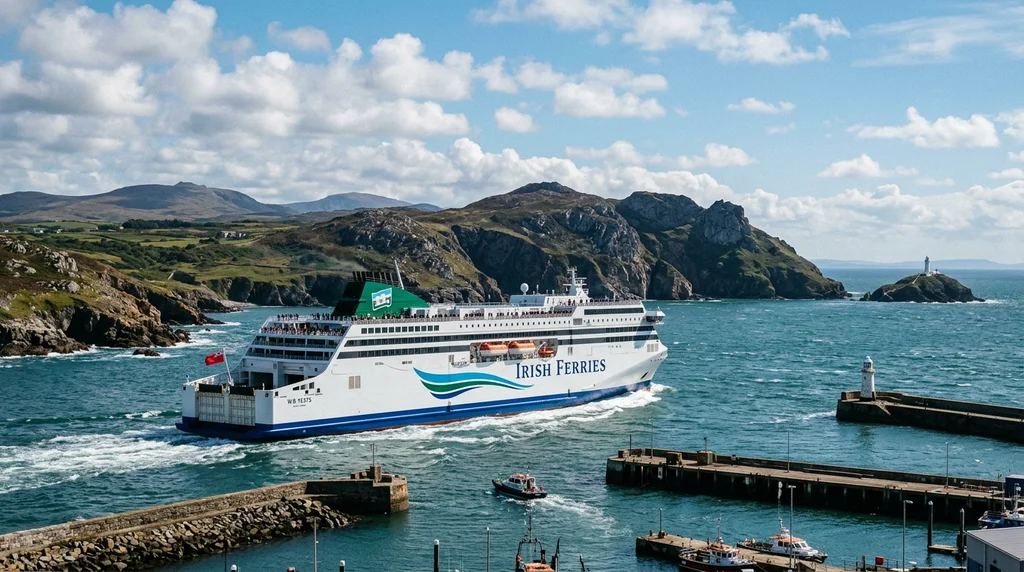
The Holyhead to Dublin ferry is the busiest and most frequent crossing between Great Britain and Ireland, linking North Wales directly with the Irish capital. It's the natural choice for Dublin, the east coast, and much of the island beyond.
Two operators run the route — Stena Line and Irish Ferries — with up to eight sailings a day between them, on ships ranging from large cruise ferries to a fast catamaran. This guide covers the operators, ships, ports and how to book.
Holyhead to Dublin operators and ships
Stena Line
- ShipStena Adventurer / Stena Estrid
- Duration~3h 15m
- Availabilityup to several daily
Irish Ferries (cruise)
- ShipUlysses
- Duration~3h 15m
- Availabilityup to 4 daily
Irish Ferries (fast)
- ShipDublin Swift
- Duration~2 hours
- Availabilityseasonal
| Operator | Ship | Duration | Availability |
|---|---|---|---|
| Stena Line | Stena Adventurer / Stena Estrid | ~3h 15m | up to several daily |
| Irish Ferries (cruise) | Ulysses | ~3h 15m | up to 4 daily |
| Irish Ferries (fast) | Dublin Swift | ~2 hours | seasonal |
Between the two operators there are up to eight sailings a day. The Dublin Swift is the only fast ferry on the Irish Sea, crossing in just over two hours in the summer season.
Choosing your crossing
You've got a real choice on this route:
- •
For comfort and stability: a large cruise ferry — Stena's Adventurer or Estrid, or Irish Ferries' Ulysses — steadier in rough seas and better for families, around 3h 15m
- •
For speed: the Dublin Swift fast ferry, just over two hours, though seasonal and weather-dependent
- •
For frequency: with two operators, there's almost always a sailing that fits your day
Holyhead port
Holyhead sits on the Isle of Anglesey in North Wales, reached by the A55 expressway or by rail — the railway station is right next to the ferry terminal, with direct connections across Britain.
There's short- and long-stay parking near the terminal, plus a park-and-ride with a shuttle. It's worth arriving early: around 45–60 minutes before departure as a foot passenger, and 60–90 minutes with a vehicle.
Dublin Port
Dublin Port is Ireland's busiest ferry port, just two to four miles from the city centre — around a 15 to 30 minute drive depending on traffic and terminal. Stena Line uses Terminal 2 and Irish Ferries Terminal 1.
There's no train station at the port itself, but an Express Bus Transfer and public buses run to the city centre and Connolly Station, and taxis are readily available. Drivers reach the M50 and M1 motorways quickly via the Dublin Port Tunnel.
Rail & Sail: train and ferry combined
If you're travelling without a car, a Rail & Sail (SailRail) ticket combines train travel and the ferry crossing into a single fare, often much cheaper than buying them separately.
It works from stations across Britain to Dublin, and the ferry-terminal rail connection at Holyhead makes it seamless. It's one of the best-value ways to reach Dublin as a foot passenger.
Booking and travel tips
A few practical things to know:
- •
Vehicles: book ahead in summer — car deck space sells out on busy sailings
- •
Foot passengers: welcome on both operators, with more flexibility than drivers
- •
No baggage charges: with a car, pack as much as you like
- •
Pets: carried by both operators, with policies varying by ship
- •
Documents: bring a valid passport or accepted travel document
Frequently Asked Questions
How long is the Holyhead to Dublin ferry?
Around 3 hours 15 minutes on the cruise ferries, or just over two hours on the seasonal Dublin Swift fast ferry.
Who runs the Holyhead to Dublin ferry?
Two operators — Stena Line and Irish Ferries — with up to eight sailings a day between them.
What is the fastest Holyhead to Dublin ferry?
Irish Ferries' Dublin Swift, the only fast ferry on the Irish Sea, crossing in just over two hours in the summer season.
Can I take a train and ferry to Dublin?
Yes — a Rail & Sail ticket combines train travel across Britain with the ferry crossing in one fare, and Holyhead's station is next to the terminal.
How far is Dublin Port from the city centre?
Around two to four miles — a 15 to 30 minute drive, or a short bus or taxi ride.